Newsy
Apple Business wystartowało
Co to oznacza dla administratorów MDM?

filtruj po kategorii
Filtruj po autorze

Co to oznacza dla administratorów MDM?

Twój cyfrowy ochroniarz, który nie śpi (i nie bierze urlopu)

Jak Samsung zamyka drzwi, których inni nawet nie widzą

Praktyczny przewodnik dla Intune oraz Knox Manage

Base, Essentials, Enterprise — który plan dla jakiej firmy

Apple pozamiatało! Migracja MDM, logowanie iPhonem i inne nowości

Nowe narzędzia w rękach administratora MDM
Czyli Samsung stworzył narzędzie MDM, które mówi płynnie w trzech językach

Kompleksowy przewodnik, który zaoszczędzi Ci dziesiątki godzin

MDM - o zarządzaniu urządzeniami w organizacji
🇵🇱 Przejdź do polskiej wersji tego wpisu / Go to polish version of this post
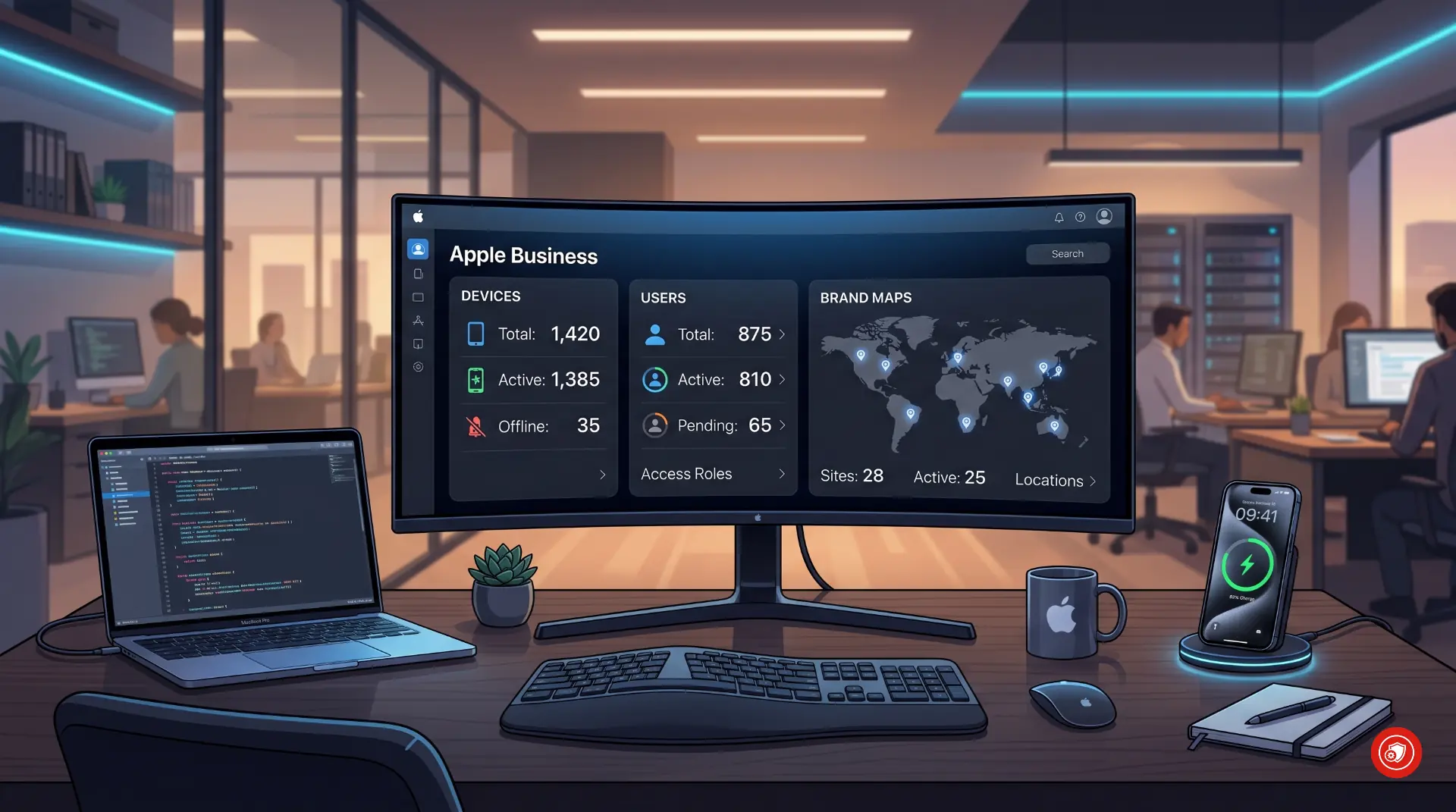
Today’s topic has been heating up forums and groups for admins managing fleets bearing the bitten apple logo for several days now. On April 14, 2026, the Cupertino giant dropped a small bomb — it launched Apple Business. This is a new, unified platform that replaces three previously separate services in one fell swoop: Apple Business Manager (ABM), Apple Business Essentials (ABE), and Apple Business Connect (ABC).
One environment instead of three. Built-in MDM without an additional subscription. Mail and calendar with a custom domain. Brand and location management in Apple Maps. And on top of all that — a free entry tier.
Does this sound like the typical product consolidation Apple serves up every few years? Maybe. But beneath the surface of this “tidying up the offering” lies a move that significantly shifts the balance of power in the MDM market — particularly in the small and medium business segment. And that’s exactly why I sat down at the keyboard today, because this topic deserves far more than just copy-pasting a press release.
So, let’s get to it!

To understand the scale and purpose of these changes, we first need to recall what the world of Apple business services looked like just a week ago. Let’s be blunt: it was scattered across three separate platforms, each doing its own thing, and none of them communicating with the others in the way we’d expect in 2026.
Three services. Different logins. Three different philosophies. And zero integration. An administrator who wanted to manage devices, deploy apps, and also make sure the company was displaying correctly in Apple Maps had to juggle three separate environments. (Seriously, Apple, who did this serve?).
Apple Business finally puts an end to this mess.
From April 14, 2026, at business.apple.com you’ll find one unified environment, available in over 200 countries and regions — including, most importantly, Poland. The platform combines device management, user management, apps, productivity, and brand management in one elegant dashboard.
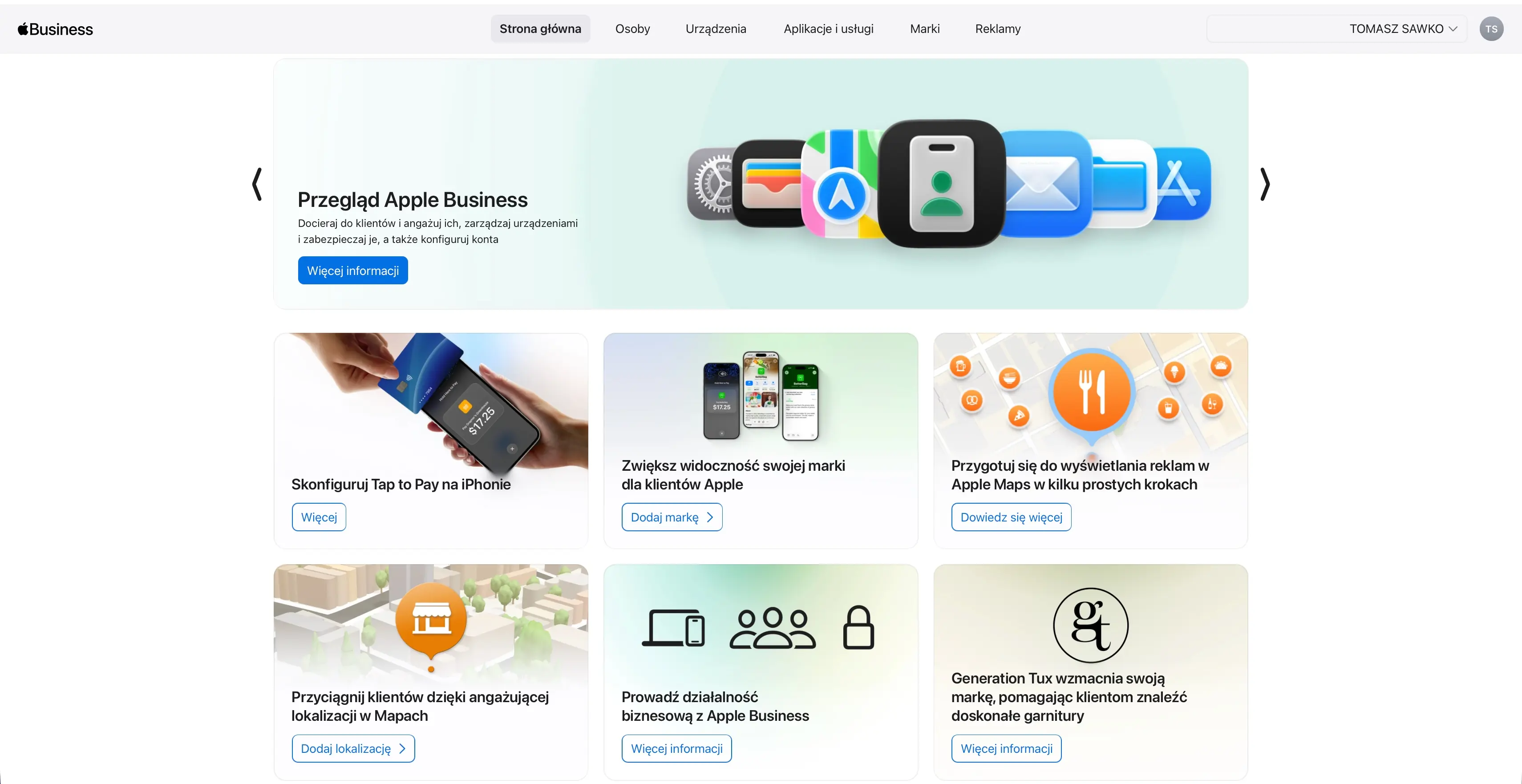
What about migration? Apple rose to the occasion. Migration from the previous services is automatic — data from ABM, ABE, and ABC transfers to the new environment without the need to tear your hair out or manually reconfigure everything.
VERY IMPORTANT: The three previous platforms are no longer available. This is not a “new alongside the old” situation. Apple Business simply replaces them. Former ABE customers will no longer be charged a monthly fee for device management — because, take note, MDM is now part of the free platform.
Apple’s Susan Prescott put it quite plainly: the company is unifying its strongest business products into a single platform. Let’s take a closer look at the most interesting elements of this “all-in-one machine.”
This is the change that has caused / will cause the biggest earthquake. Apple Business offers built-in mobile device management (MDM) directly from within the platform, with no separate subscription. Until now, this functionality was available exclusively within ABE — for a fee and only across the ocean.
Now, built-in MDM is coming to over 200 countries, including Poland. For free.
What do we get in the package?
Before you panic that your current system is now unnecessary, let me clarify: Apple Business remains 100% compatible with third-party MDM solutions. If you work day-to-day with TechStep Essentials MDM (formerly FAMOC), the excellent Polish Proget MDM, Samsung’s Knox Manage (yes, Knox Manage also manages Apple hardware — I wrote about this a while back), or Microsoft Intune — the integration works exactly the same as it did before with ABM. APNs certificates, VPP tokens, device assignment to a server — that foundation remains untouched.
But — and here’s that famous catch — for an architecture firm with 15 MacBooks and zero budget for dedicated IT, Apple’s built-in MDM may turn out to be entirely sufficient.
Another new feature is so-called Blueprints — ready-made configuration templates. They allow people who serve as the unofficial “computer person” to prepare sets of settings, apps, and policies for specific roles or departments.
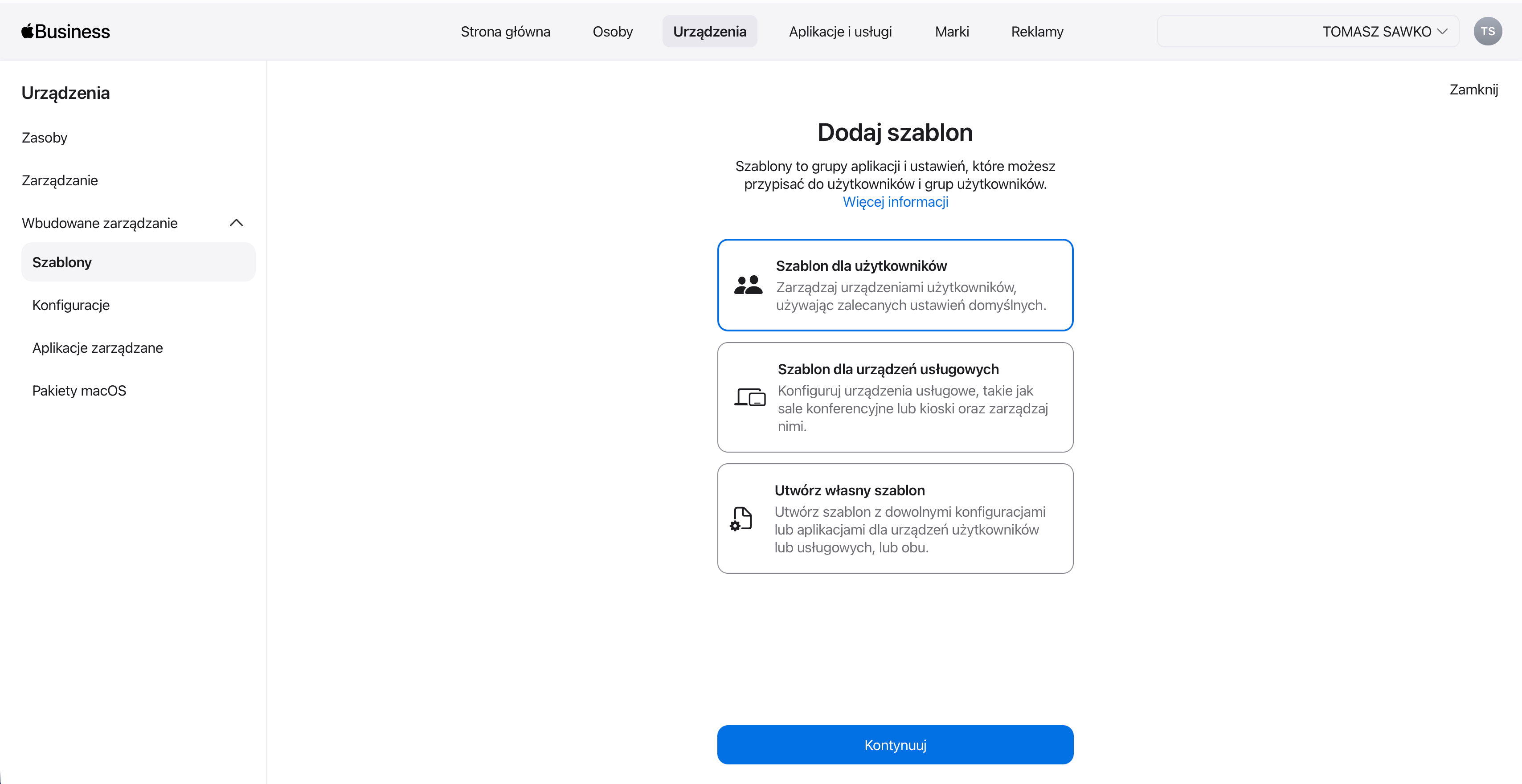
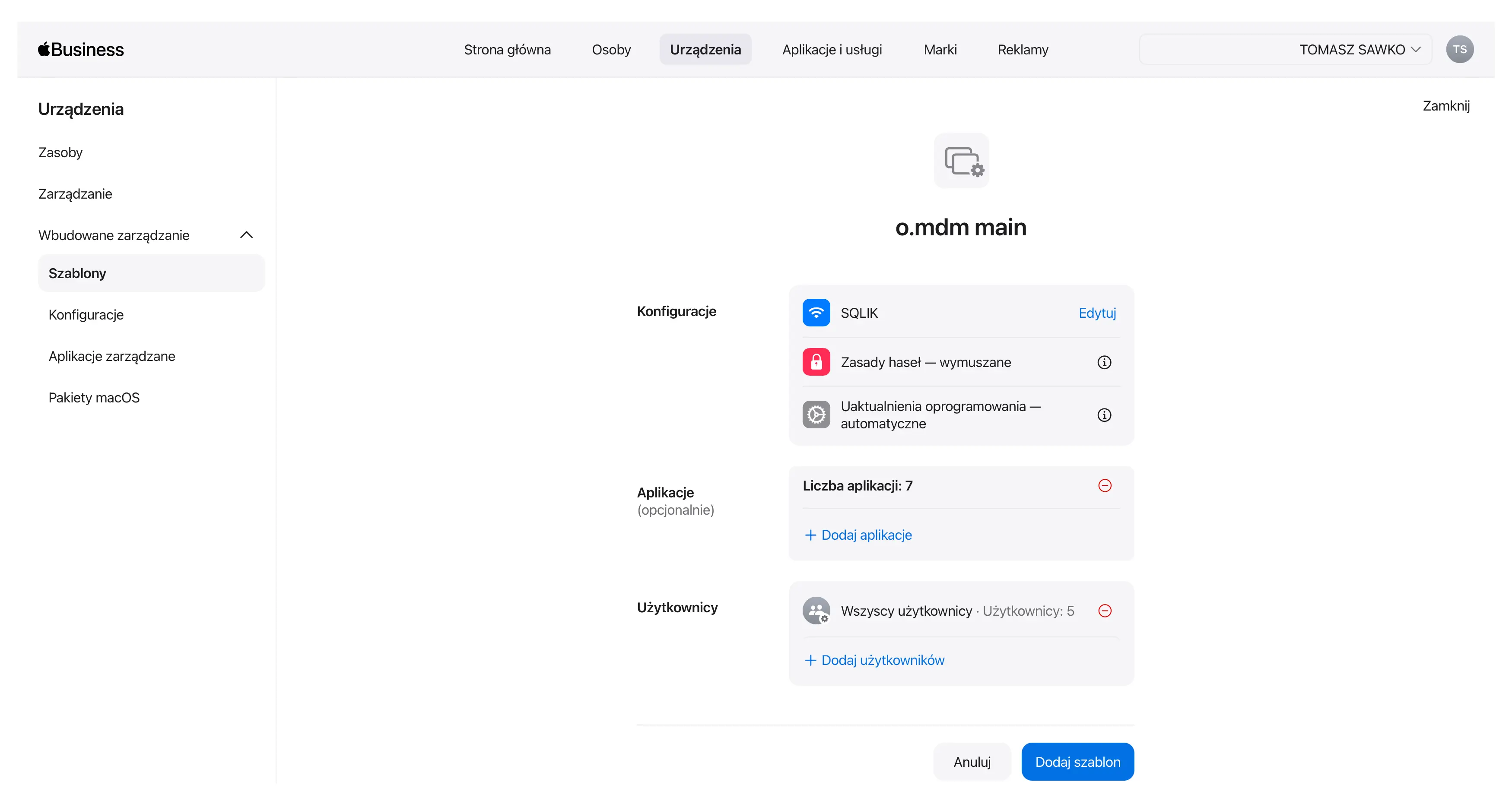
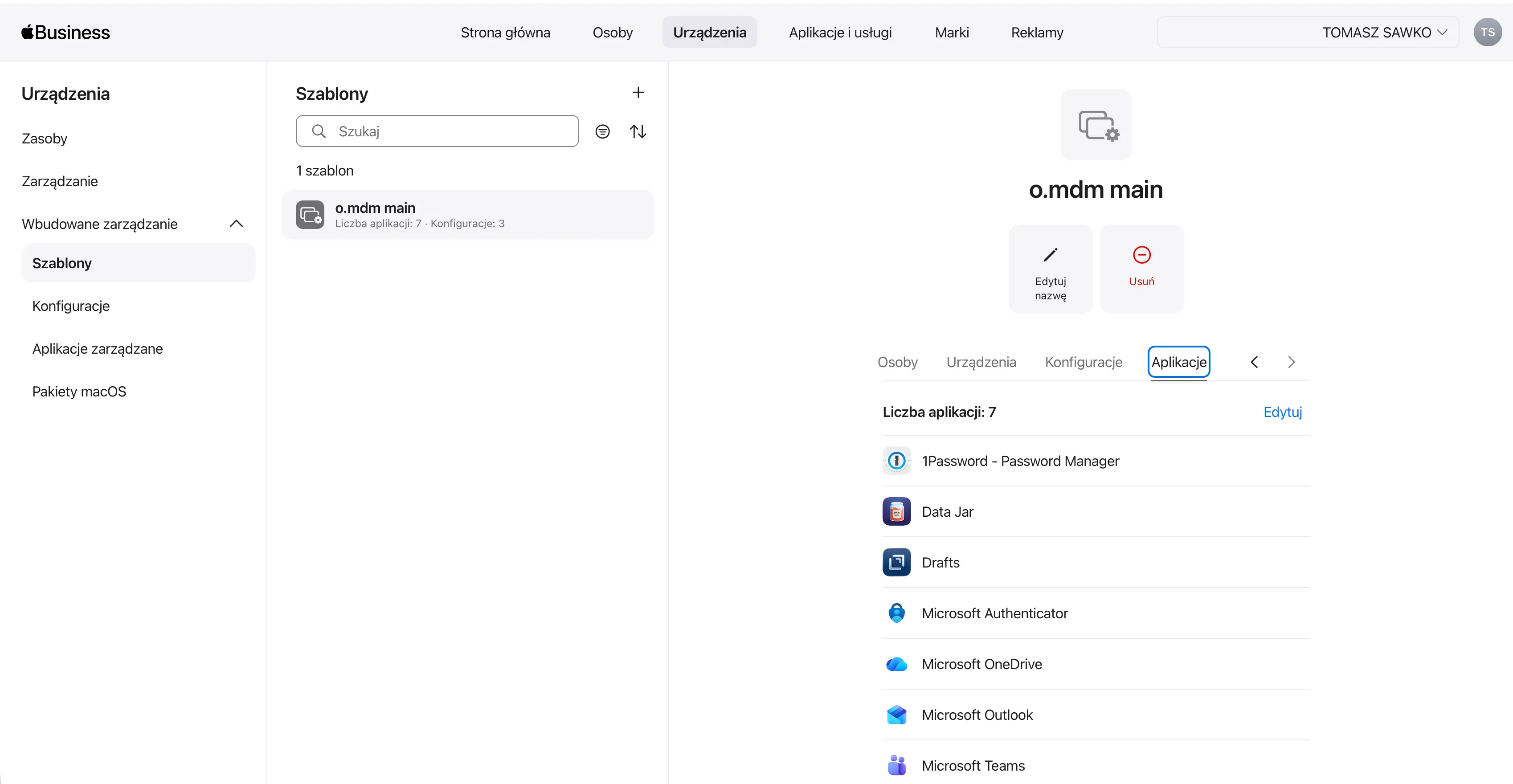
In practice: instead of “clicking through” each iPhone manually, you define a Blueprint once and then apply it to an entire group of sales staff. Sure, every mature MDM system, such as Proget or TechStep, has had advanced configuration profiles and dynamic groups for years. But Blueprints have been tailored for companies that don’t have and never will have a professional administrator. Apple is aiming squarely at the segment where the IT department is Andrew from accounting.
Blueprints work great with zero-touch deployment. An employee takes the phone out of the box, logs in, and the device automatically downloads the defined templates. No visit to the admin required. For those of us who have been using Automated Device Enrollment (formerly DEP) for years, this is nothing new. What is new is that Apple now provides this as a standalone, complete mechanism without needing to tie it to an external MDM.
The platform relies heavily on Managed Apple Accounts (formerly Managed Apple IDs). We know the mechanism well, but now it becomes the absolute center of the identity architecture.
Cryptographic separation of data on the device ensures that an employee can safely use a personal iPhone for work, without the risk of mixing company emails with personal vacation photos. For companies that need to comply with GDPR requirements and internal compliance — this isn’t a nice extra, it’s an absolute requirement.
The best part of all this is that Apple Business allows for the automatic creation of these accounts through integration with identity providers (IdPs) such as Microsoft Entra ID or Google Workspace. You sync accounts, enable federation, and you’re done — no manual account creation in the Apple portal. I wrote about this integration at last year’s WWDC, but now, as part of the new platform, it makes even more sense. Apple isn’t trying to forcibly replace your Entra ID — it’s simply plugging into it neatly.
This was the moment where I raised an eyebrow slightly. Apple Business introduces integrated mail, calendar, and user directory services with support for a custom company domain. You can connect an existing one or purchase a new one directly from within Apple Business.
Calendar delegation, a shared address book, business cards — Apple is clearly muscling its way into a market dominated by Microsoft 365 and Google Workspace.
BUT BEWARE: Before you start writing emails to management about canceling Office licenses — at launch, the Mail, Calendar, and Directory features are not available in Poland. According to the official documentation, this slice of the pie is currently an exclusive club for users in the USA. It’s worth keeping this in mind to avoid disappointment.
The consolidation has also absorbed the former Apple Business Connect. Here you’ll find tools for managing your company’s image in Apple Maps, Wallet, and Apple Mail. You can add a logo, photos, opening hours, and actions like “Book Now.”
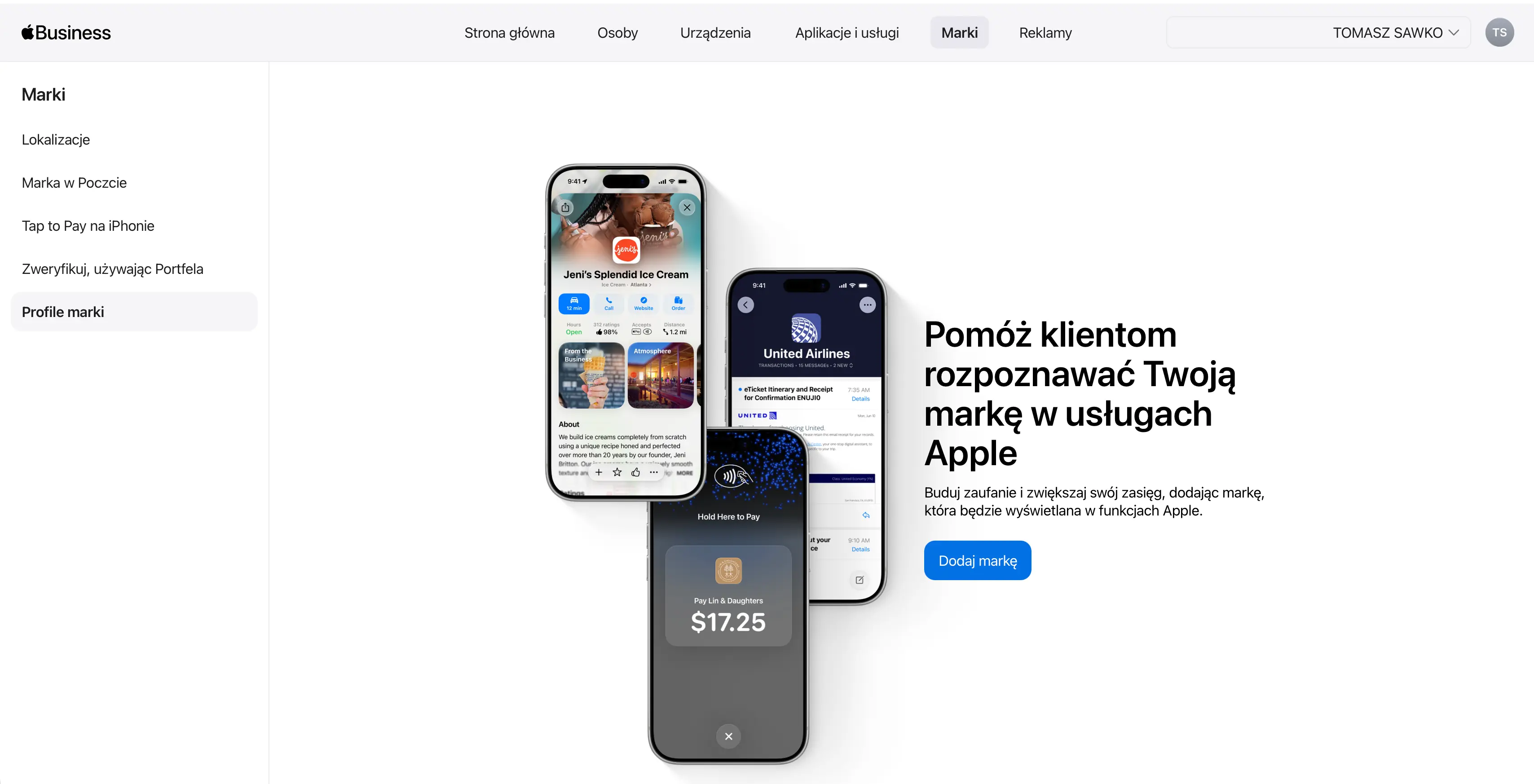
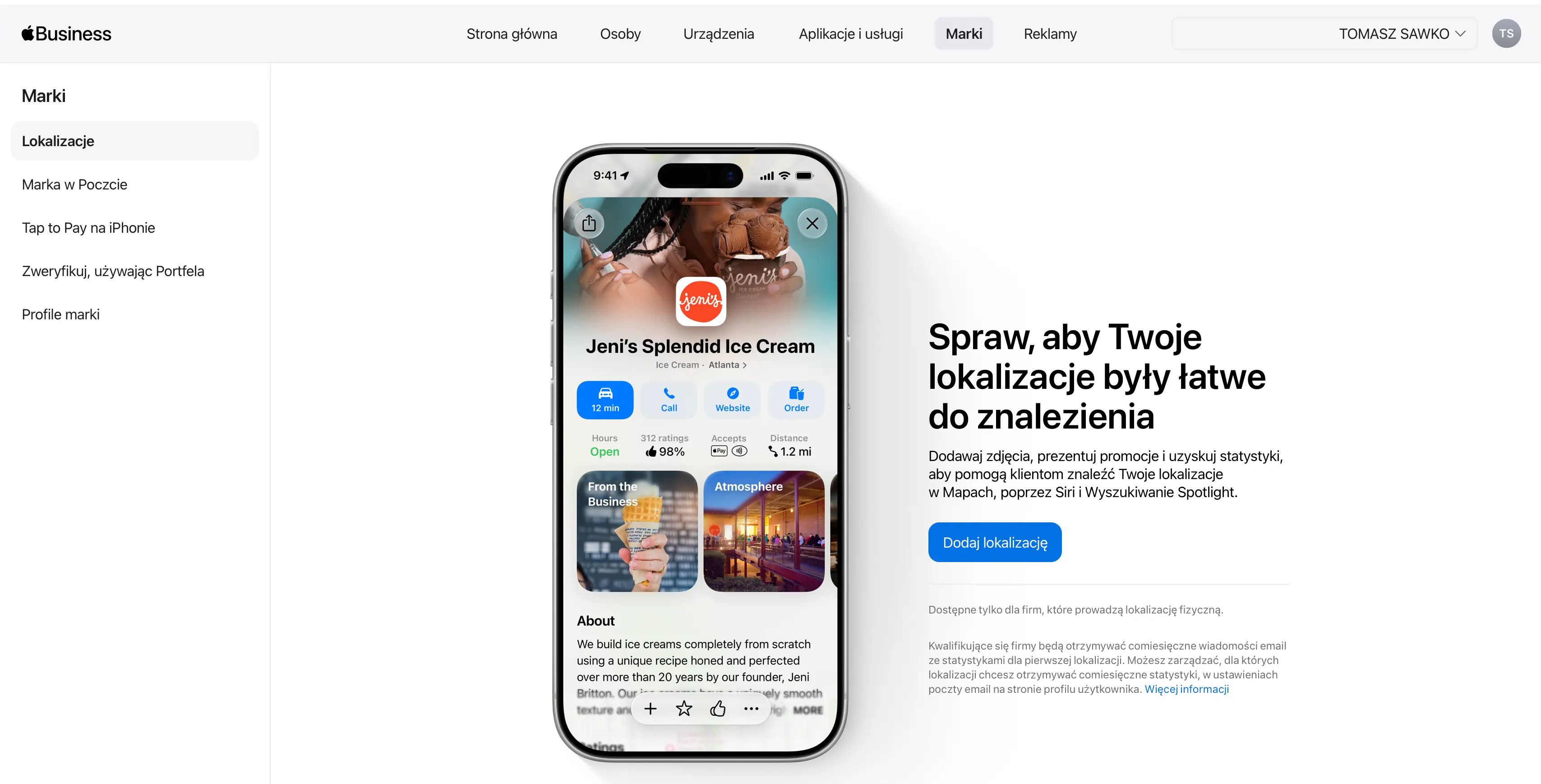
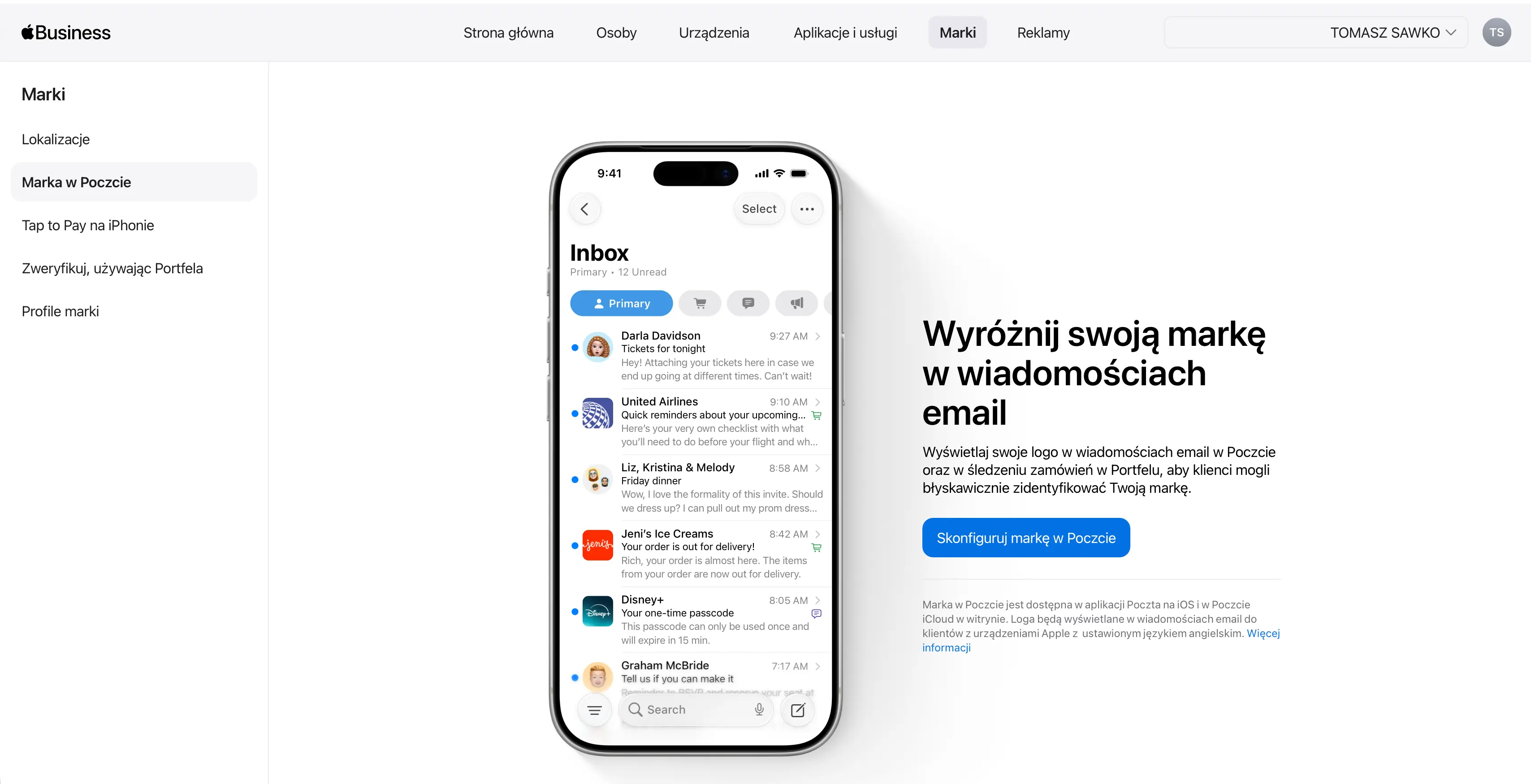
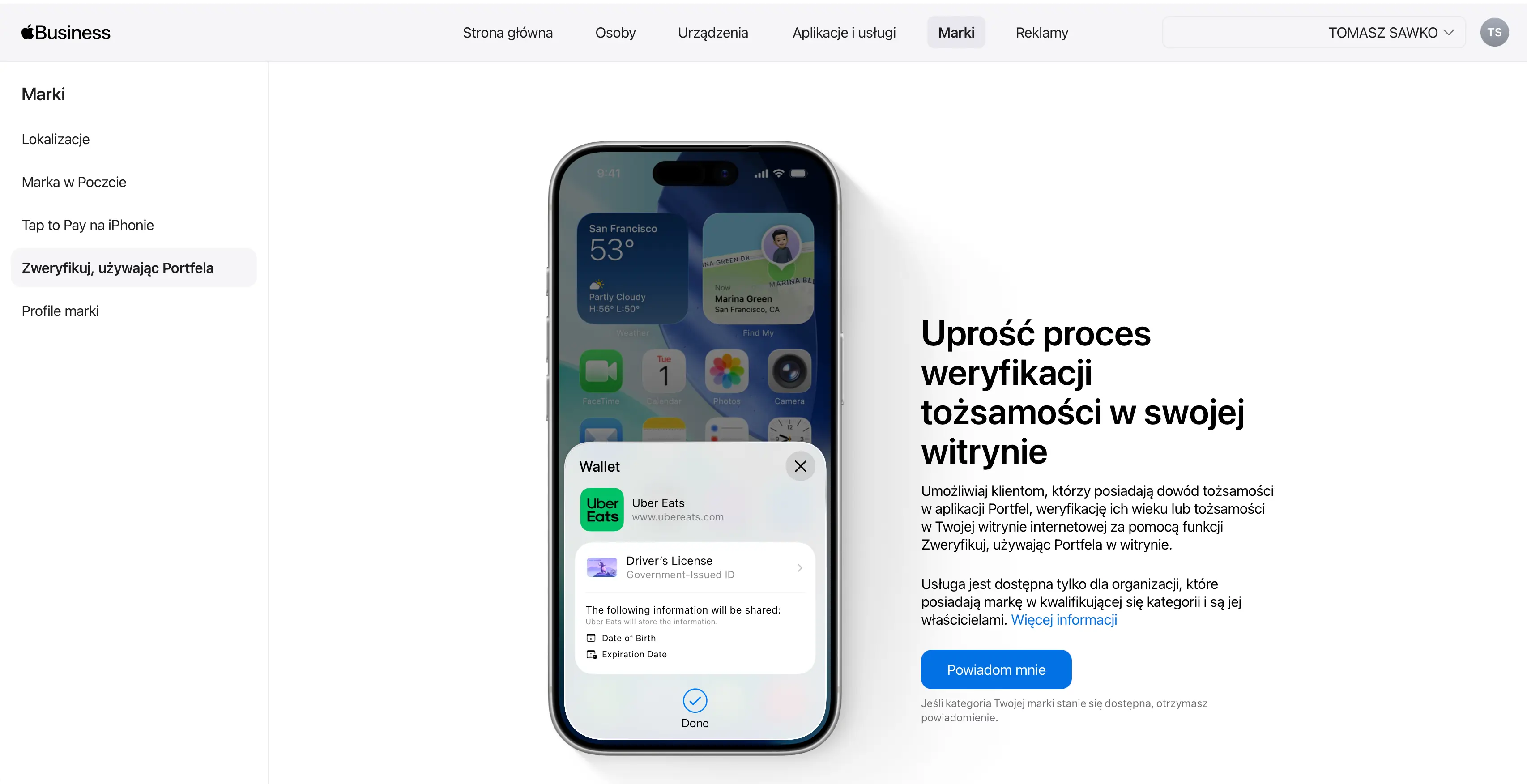
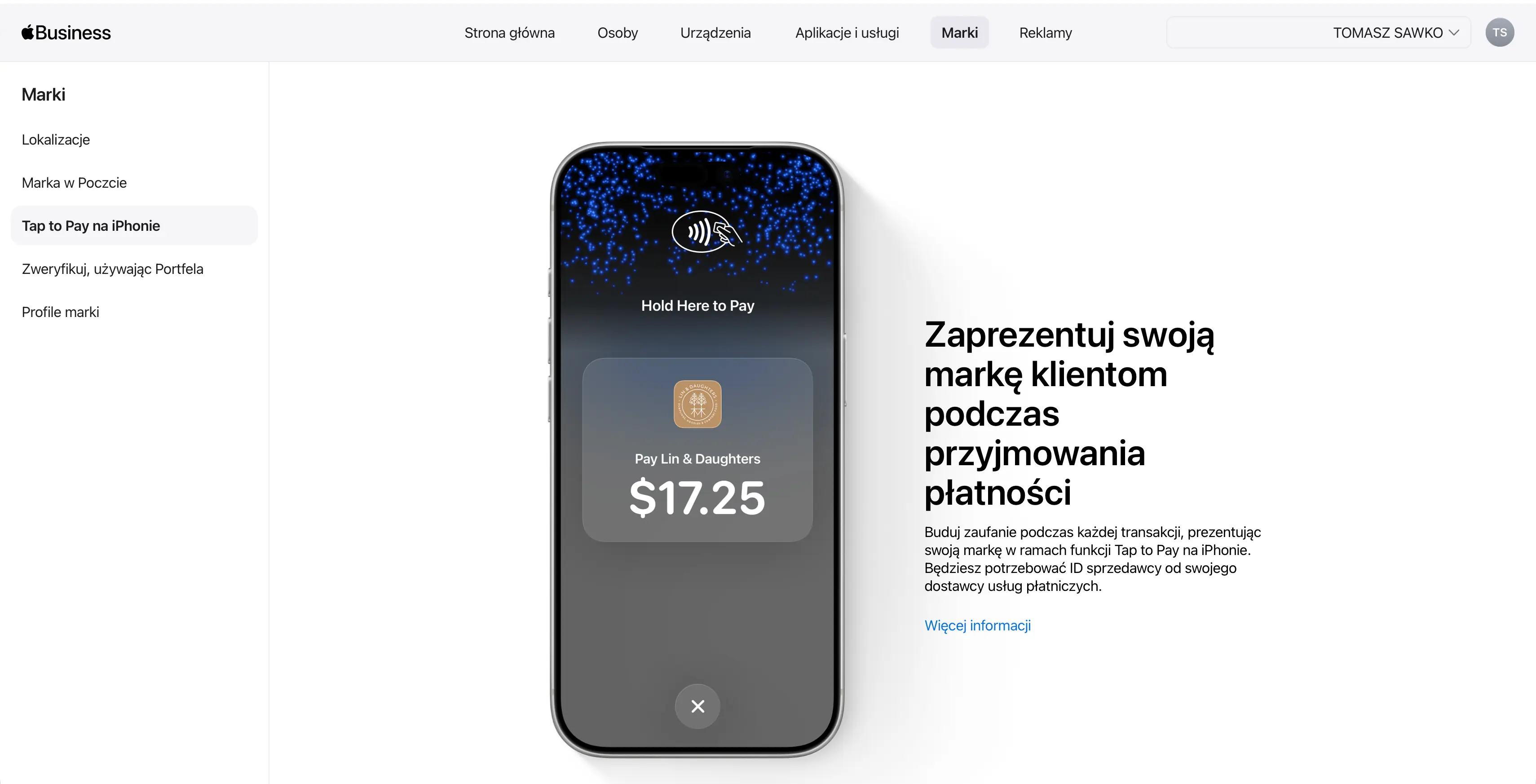
On top of that, there’s analytics for searches and profile interactions. Honestly? These are more like toys for the marketing department. But in smaller companies, where the IT admin is the same person who manages the company’s Facebook — having all of this in one panel alongside device management simply makes sense.
We also have a refreshed mobile app — Apple Business 2.0 (replacing the Apple Business Essentials app). Employees can use it to install assigned work apps, search for company contacts, or report IT issues. An interesting addition is support for Apple Vision Pro.
Pay attention to the requirements. The app and new directory services require iOS 26, iPadOS 26, or macOS 26. The new platform will therefore truly spread its wings only in the autumn, after the traditional wave of system updates.
So how do these global announcements translate to our Polish reality? I’ve compiled this for you in a quick comparison table (status at service launch):
| Feature | Poland | USA |
|---|---|---|
| Brand and location management | Yes | Yes |
| Branded mail (company logo in Mail) | Yes | Yes |
| Built-in device management (MDM) | Yes | Yes |
| Purchase of AppleCare+ for Business | No | Yes |
| Purchase of additional iCloud storage | No | Yes |
| App distribution (Apps and Books) | Yes | Yes |
| Book distribution | Yes | Yes |
| Mail, calendar, and user directory | No | Yes |
| Managed Apple Accounts | Yes | Yes |
| Tap to Pay on iPhone (accepting payments) | Yes | Yes |
| Identity verification via Wallet in browser | No | Yes |
| Zero-touch device deployment | Yes | Yes |
As you can see, Poland has received a truly solid foundation. Free built-in MDM, zero-touch, and identity management is a powerful package for zero dollars. The lack of the ability to purchase business iCloud or mail stings, but it doesn’t block the platform’s core functionality.
We’re getting to the heart of the matter. Apple has just handed out free, built-in MDM with zero-touch mechanisms and Blueprints in over 200 countries.
Do corporations and large environments have reason for nervous moves? Absolutely not. If you’re managing a fleet of several thousand devices, you need powerful weaponry. Advanced compliance policies, granular patch management, integrations with SIEM/EDR systems, workflow automation — these are the territories where TechStep Essentials MDM, Proget, Knox Manage, or Intune face no competition from Apple Business. Apple’s built-in solution is simply too basic for that. Especially in multi-platform organizations (where iPhones sit alongside Samsungs and Motorolas), or where an operator like Plus — a certified Proget MDM partner and TechStep partner — provides you with local support, on-premise architecture, and consulting. Apple won’t give you that.
But for the aforementioned advertising agency with 30 devices? The calculation is downright brutal. Why pay a third-party vendor (even those $1–4 per month per license from cheaper players in the foreign market like Jamf Now or Mosyle), when Apple gives it out-of-the-box and for free?
From my perspective, this is a classic platform move, familiar from Microsoft Teams or Google Workspace. Give the foundation away for free, make businesses dependent on your ecosystem (management, identity, hardware), and monetize premium services (once expansions like iCloud for Business or paid support reach Poland). Apple is no longer just a “seller of great hardware.” It wants to be the operating system for the entire SMB business world.
To be clear — Apple Business absolutely does not block or make life difficult for companies using external UEM systems. The change under the hood is purely cosmetic navigation.
You set up an MDM server in the new Apple Business panel, generate a token, drop it into your Proget, Intune, or TechStep, and everything works like a charm. What’s more, remember the news from WWDC 2025 — native MDM migration, which (from iOS 26 / macOS 26) allows you to move a device from one system to another without a dramatic wipe and factory reset. All of this is managed from within the very Apple Business we’ve been discussing. Magic, right?
Using Apple Business as a platform (including built-in MDM) is 100% free.
Paid (currently only in the USA) are the add-ons:
What will the coming quarters bring? I’m betting on the expansion of mail features to Europe and stronger development of the API for administrators. If Apple starts adding advanced reporting or compliance modules to its free MDM in the future, the bigger players in the market will have to seriously reconsider their pricing strategy for smaller clients. For now, professional UEM systems can sleep soundly, while small businesses have gained a tool that officially renders the excuse “fleet management is too expensive for us” obsolete.
Until next time!

Apple Newsroom — Introducing Apple Business (March 24, 2026, updated April 14, 2026)
Apple Support — Available services and features for Apple Business
MacRumors — Apple Launches New All-in-One Apple Business Platform (April 14, 2026)
9to5Mac — Apple releases revamped Business app with Apple Vision Pro support (April 14, 2026)
Microsoft Community Hub — Apple making device migration to Microsoft Intune easy
Apple Business — business.apple.com


 Follow.it